Cloud Hosting vs Shared Hosting: Which Web Hosting Should You Actually Choose
Cloud Hosting vs Shared Hosting: Which One Gives You Better Speed, Security, and Value in 2026?

When I launched my first website, I picked the cheapest hosting plan I could find. It was shared hosting. It worked at the beginning, but as traffic grew, my site became slow, sometimes went down, and rankings dropped. That’s when I moved to cloud hosting and saw a real difference in speed and stability.
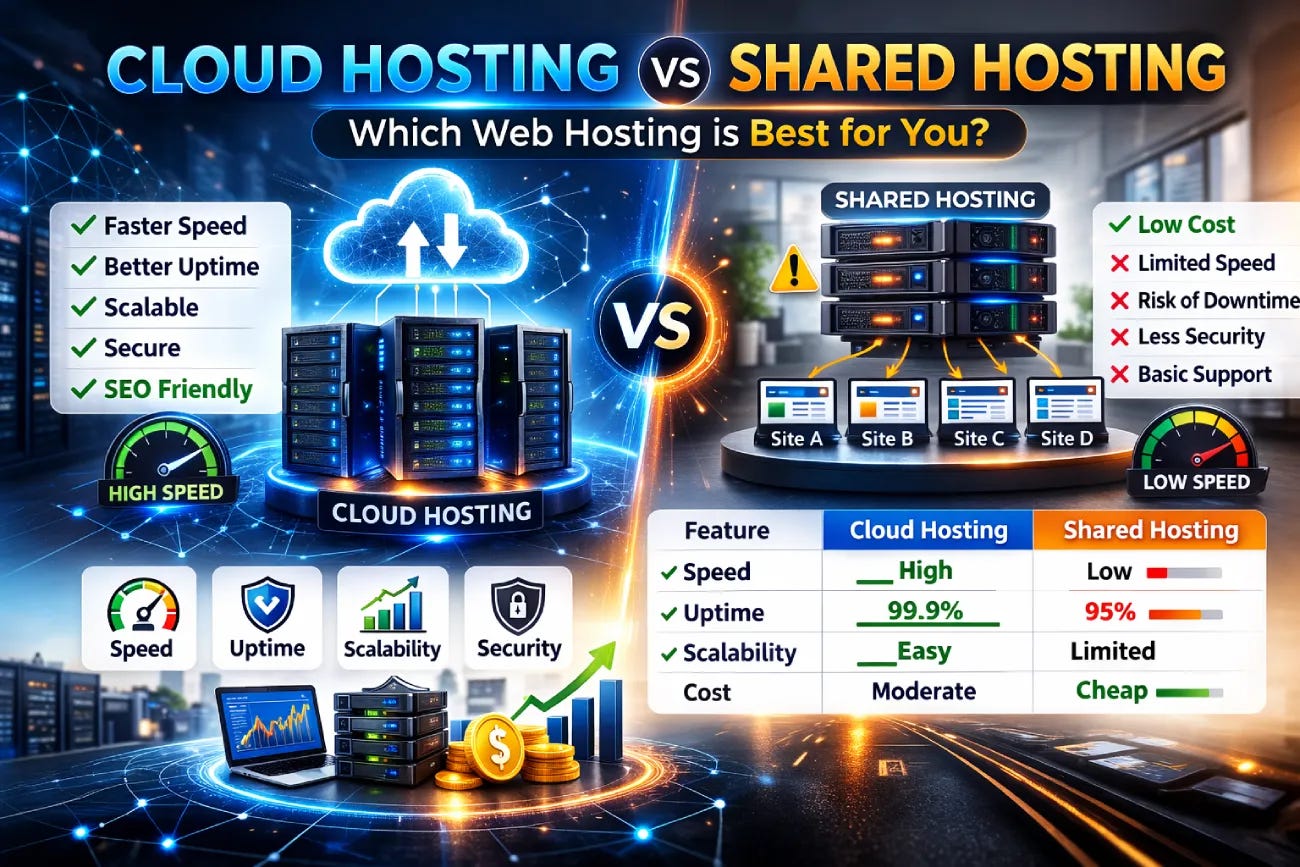
Many beginners ask the same question we once asked: cloud hosting vs shared hosting — which one is better?
The answer depends on what you want from your website. Let me walk you through this in a practical way so you can choose the right hosting without wasting money or hurting your SEO.
What Is Shared Hosting?
Shared hosting is the most basic and affordable type of web hosting. Your website lives on a server with hundreds of other websites. All of you share the same resources — CPU, RAM, storage, and bandwidth.
This is why shared hosting is cheap. The cost of the server is divided among many users.
For beginners, this is often the starting point because:
It is affordable
It is easy to set up
It requires no technical knowledge
Most providers include one-click WordPress install
If you are starting a blog, a portfolio site, or a small business website with low traffic, shared hosting can work well.
What Shared Hosting Really Feels Like
With shared hosting, your website lives on a server with many other websites. You all use the same CPU, RAM, and bandwidth.
I like to explain it like this: it’s a shared apartment. It’s cheap and easy to move into, but you don’t control the resources.
When I used shared hosting for a small blog, it was fine at first. The setup was simple, WordPress installed in one click, and I didn’t need technical knowledge.
Shared hosting works well for:
Students building projects
Small local business pages
Portfolio or static websites
Low-traffic WordPress sites
You can launch quickly and keep costs low.
The Problems We Face with Shared Hosting
As soon as traffic increases, shared hosting shows its limits.
We started noticing slower page speed, especially during peak hours. Sometimes another website on the same server used too many resources and our site became slow even though we didn’t change anything.
This leads to:
Slower loading time
Poor Core Web Vitals
Higher bounce rate
Lower SEO performance
Security is another concern. Even though good hosts isolate accounts, you are still on the same server with many unknown websites.
Shared hosting is good for starting, but it is not built for growth.
What Cloud Hosting Feels Like in Real Use
When we moved to cloud hosting, the biggest change was performance.
Cloud hosting does not depend on one physical server. Your website runs on a network of servers. Resources scale automatically when traffic increases.
The difference we noticed:
Faster loading pages
Better uptime
Stable performance during traffic spikes
Improved Google rankings
It felt like moving from a shared apartment to your own scalable workspace.
What Is Cloud Hosting?
Cloud hosting works differently. Instead of using one physical server, your website runs on a network of connected servers. Your resources are not limited to a single machine.
If one server fails, another takes over. If traffic increases, resources scale automatically.
This makes cloud hosting:
Faster
More stable
Highly scalable
Better for high-traffic websites
You are not sharing fixed resources with hundreds of sites. You are using a distributed system that adjusts based on demand.
Why Cloud Hosting Is Better for SEO
Speed is a ranking factor. We saw better crawl activity and faster indexing after switching to cloud hosting.
Cloud hosting improves:
Page speed
Server response time
Uptime reliability
User experience
These directly affect SEO.
When your site loads faster, visitors stay longer, and Google trusts your site more.
Cloud Hosting vs Shared Hosting: Real Comparison
Shared hosting is affordable and beginner friendly. It works for small websites that don’t get much traffic.
Cloud hosting is built for performance and scaling. It handles traffic spikes without slowing down and provides better stability.
Shared hosting has fixed resources. Cloud hosting allows you to scale CPU, RAM, and storage without migrating your site.
Shared hosting depends on one server. Cloud hosting uses multiple servers, which means better uptime.
Cost Difference and Value
Shared hosting is cheaper, which is why most beginners start there.
Cloud hosting costs more, but it delivers better speed and reliability. For business websites, affiliate sites, or eCommerce stores, the performance gain is worth the price.
We see hosting as an investment. Slow hosting costs rankings and conversions.
When We Recommend Shared Hosting
Shared hosting is still a good option when:
You are launching your first blog
Your traffic is very low
You need the lowest possible cost
You are testing a niche site
It helps you start quickly without technical complexity.
When We Recommend Cloud Hosting
Cloud hosting makes more sense when:
Your site is growing
You care about SEO and speed
You run an online business
You manage client websites
You expect traffic spikes
It gives you the performance and scalability needed for serious projects.
A Smart Strategy That Works
We often recommend starting with shared hosting and moving to cloud hosting once traffic grows.
This keeps your initial costs low and allows you to upgrade when your site starts ranking and generating revenue.
Many hosting providers now offer easy upgrades without manual migration.
Final Thoughts
Shared hosting helps you start. Cloud hosting helps you grow.
If your goal is learning, testing, or running a small website, shared hosting is enough.
If your goal is rankings, traffic, and revenue, cloud hosting is the better long-term choice.
We always focus on performance because faster websites rank better, convert better, and give users a better experience.
Choosing the right hosting is not just a technical decision. It is an SEO and business decision.